

Research & product development
JUMP TO SECTION
Our team
The team behind our research

We are creating a healthier animal world
We are proud to pave the way for insect-based pet food on a scientific basis. Together with leading universities and research partners, Petgood's veterinary team advances the research on the health benefits of insect protein.
Responsible for our work on product development and research is our knowledgeable chief veterinarian Dr. Nicky Sluczanowski. Together with our research partners she leads scientific projects, and is today one of the most prominent veterinarians in the world in the field. She has taken part in a number of articles and podcasts.
Get to know Nicky
Nicky is a small animal veterinarian from Adelaide, Australia, with long clinical experience. In Adelaide she still works part-time caring for dogs and cats (and the occasional kangaroo) at the Adelaide Animal Emergency & Referral Centre. Nicky's home is also home to the cats Winter and Autumn, and she has a great interest in beekeeping.
Podcasts with Nicky
Below you'll find a selection of the podcast episodes where our chief veterinarian Nicky has taken part to share her knowledge about developing insect-based products for dogs and cats.
- The Pet Nutrition Show - Talking with Petgood, Sweden's insect based pet food - open with Spotify
- Avid Research - What is it like to develop insect-based pet food? - open with Spotify
- VetEducation - Insect-based pet food, what's the buzz? - listen on VetEducation's website
Scientific article with Nicky - health benefits of insect fat
Petgood's chief veterinarian Dr Nicky Sluczanowski is co-author of a scientific article examining potential benefits of fat from black soldier fly larvae in pet food. You can access the full article here. Among other things, the article describes the following:
- Brain health in ageing dogs: The medium-chain triglyceride lauric acid is dominant in the fat from the black soldier fly larva and may have significant applications as a supplement for the brain health of ageing dogs. It has shown potential to improve clinical symptoms of both dementia and epilepsy.
- Antimicrobial activity: Fat from the black soldier fly larva has documented strong antimicrobial properties against pathogenic bacterial species, including Salmonella typhimurium, E. coli, Clostridium perfringens and Pseudomonas aureginosa.
In brief
Research in brief
Scientific basis
Together with leading universities and research partners, Petgood's veterinary team advances the research on the health benefits of insect protein. The work is led by our chief veterinarian Dr. Nicky Sluczanowski.
Allergy symptoms (SLU)
In a study at the Swedish University of Agricultural Sciences (SLU), 79 % of the owners of dogs with food allergy alone reported improvement in all symptoms after switching to insect-based.
Cat food study
A scientific study on our adult cat food showed high palatability and digestibility, optimal stool quality and an increase in beneficial gut bacteria.
Better oral health
A cross-over study on dogs showed the potential of insect-based food to reduce bad breath and improve oral health.
Video
Video with Nicky
Hear our chief veterinarian talk about the nutritional content and health benefits of the insect species we use.
Benefits
Why insects?
Novel protein source
A protein the animal has never been exposed to - supports elimination diets and management of food hypersensitivity.
Highly digestible
~85 % protein digestibility - supports nutrient uptake and gastrointestinal function.
Functional gut health
Positive effects on microbial diversity and beneficial bacteria.
Consistent nutritional profile
Controlled production provides a reliable recipe and even quality - every batch.
EU-approved since 2016
The black soldier fly has been a controlled and approved feed raw material in the EU since 2016 - an established, regulated protein source.
Free from antibiotics & hormones
The larvae are naturally disease-resistant - no antibiotics, pesticides or growth hormones are needed.
Supported by FEDIAF
FEDIAF's fact sheet recognises insect-based ingredients as a safe and nutritionally valid category.
Studies
Studies
Study · Allergy
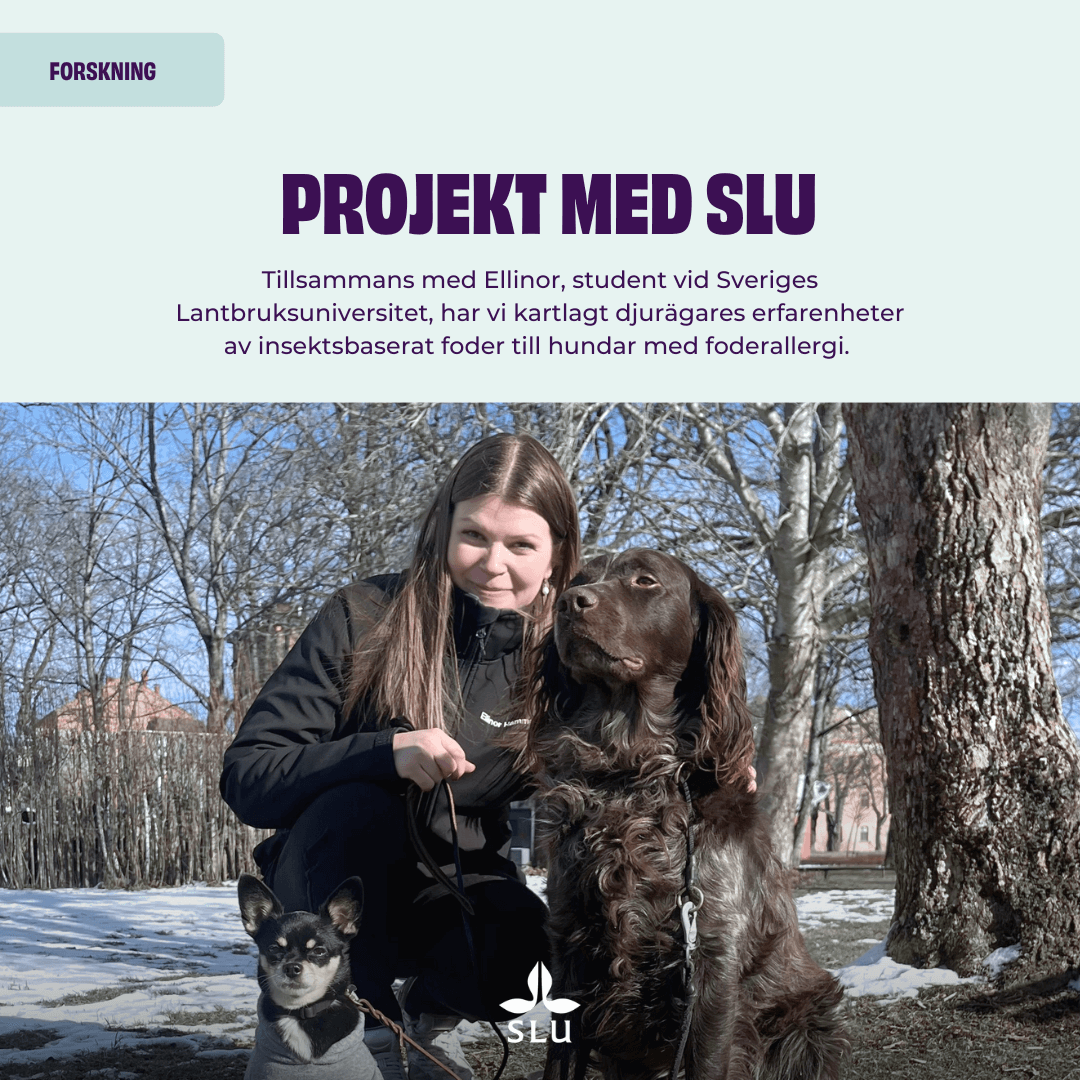
The SLU study
In a study at the Swedish University of Agricultural Sciences (SLU), 79 % of the dogs showed fewer allergy problems after switching to Petgood.
During spring 2024 Petgood collaborated with Ellinor Hammarberg, a student at SLU. For her thesis, Ellinor chose to examine how owners of dogs with diagnosed food allergy experienced their dog's symptoms after switching to insect-based. The result was predominantly positive, with a large majority seeing an improvement in the dogs' symptoms.
The results for dogs with food allergy alone showed that 79 % of the owners reported improvement in all symptoms (itching/skin irritation/red paws, ear infections, coat problems and gastrointestinal symptoms) after switching to insect-based.
Study · Cat
Study on Petgood's cat food shows health benefits
A scientific study based on our adult cat food evaluated important parameters for nutrition and health such as palatability, digestibility and effect on the gut flora. In short, the study showed that our food has high palatability and digestibility, provides optimal stool quality and can even increase the presence of beneficial gut bacteria.
- 100 % of the cats liked the food
- Over 85 % digestibility of the protein
- Increase in beneficial gut bacteria (Bifidobacterium and Megamonas)
The most important findings in the study are:
100 % of the cats liked the food
The food had very high palatability, with all participating cats liking the food and continuing to eat it throughout the study - in fact they liked the food so much that they even continued after the study had ended.
High digestibility of nutrients
Petgood's food had a high digestibility of all nutrients, and a protein digestibility of over 85 %. This is in line with levels for other high-quality premium foods made from more traditional protein sources. It means that the cat easily digests and absorbs the nutrients from our food, and utilises them in the body.
Increase in beneficial gut bacteria
Petgood's food stimulated activity in the gut flora, leading to an increase in gut bacteria considered beneficial, and a decrease in gut bacteria linked to digestive problems. An increase was observed in species such as Bifidobacterium and Megamonas, which are considered beneficial for gut health. A significant decrease in bacteria from the Clostridium group was also noted.
Study · Oral health
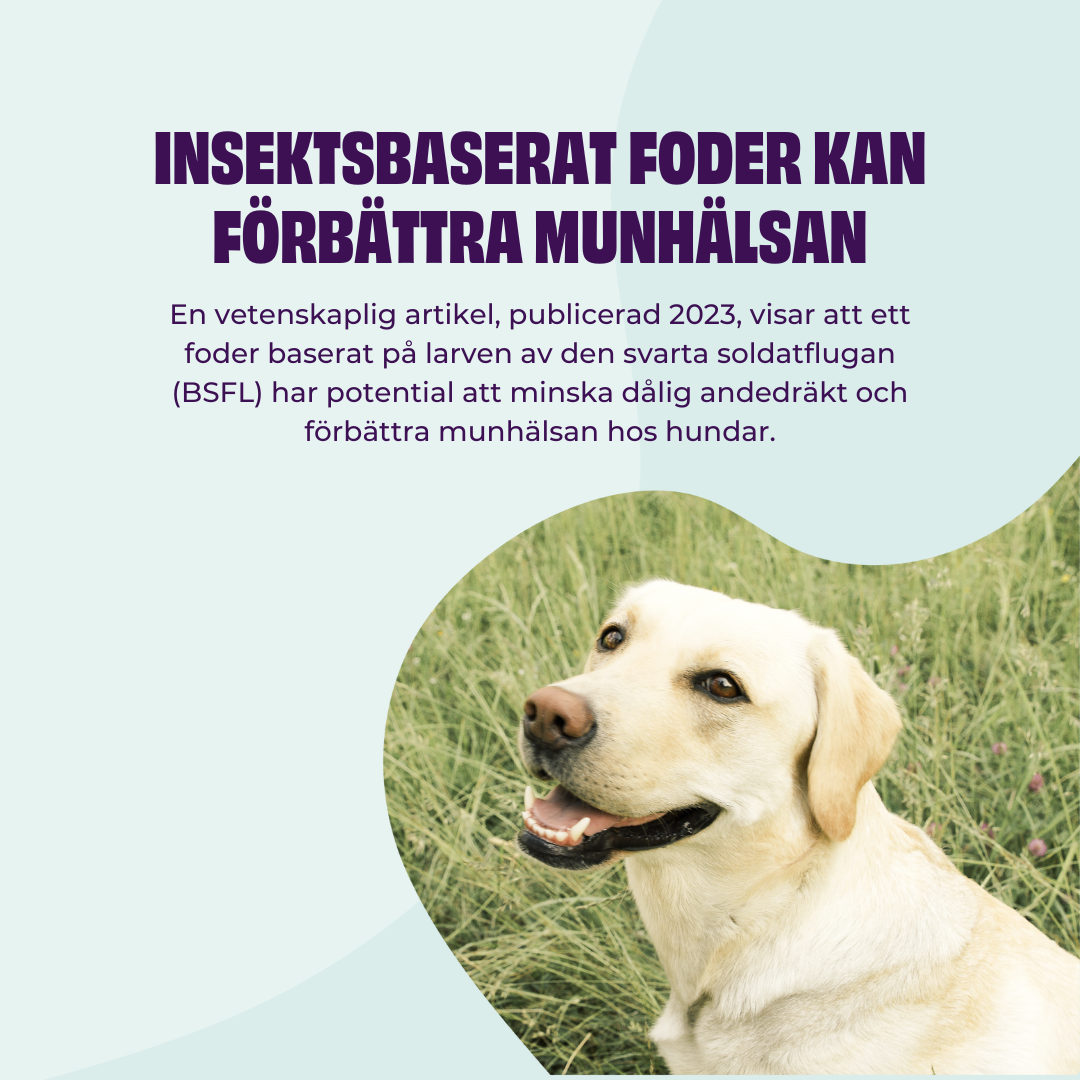
New study on the potential for better oral health
Eight dogs were fed a food based on the black soldier fly larva (BSFL) over a period of 50 days, in a cross-over study. The insect-based food was compared against a control diet based on chicken, with otherwise equivalent ingredients and nutritional value. The result showed the potential of insect-based food to reduce bad breath and improve oral health in dogs.
Improvement in the mouth's bacterial flora
Protein meal from the black soldier fly larva appears to have the potential to change the microbiota in the saliva. An increase in Moraxella bacteria was found in the group that ate the insect-based diet, according to a metagenomic analysis. This group of bacteria is considered a marker of oral health. A 7 % decrease in VSC-producing bacteria in the plaque was also found - VSC-producing bacteria are involved in the onset of bad breath and gum disease.
Evaluation of breath
The dogs showed a trend of lower scores for bad breath (odour intensity scale) when fed the diet based on the black soldier fly larva, compared with the control group.
Reference library
References and studies on insect protein for cats and dogs
Below you'll find a selection of the scientific studies published on the topic of insect protein for cats and dogs. The articles are in English only.
Protein quality
Amino acid content of selected insect species
McCusker, Buff, Yu & Fascetti (2014), Journal of Nutritional Science, vol. 3, e39. DOI: 10.1017/jns.2014.33. Insects exceeded both NRC's dog and cat requirements for all essential amino acids and crude protein, and are highlighted as practical alternatives to traditional protein sources.
In vitro digestibility and fermentability of selected insects
Bosch et al (2016), Animal Feed Science and Technology, vol. 221. DOI: 10.1016/j.anifeedsci.2016.08.018. The protein quality - based on amino acid profile and digestibility - of selected insect larvae was high, and the indigestible fractions were at least partly fermented by the dog's gut flora.
Digestibility and safety of dry black soldier fly larvae meal
Freel, McComb & Koutsos (2021), Journal of Animal Science, vol. 99(3). DOI: 10.1093/jas/skab047. BSFL meal and oil were well tolerated by dogs without affecting physiology, and can be safely included in dog food.
Evaluation of protein quality of defatted BSFL meal compared with traditional protein sources
Mioto et al (2024), Journal of Animal Science, vol. 102. DOI: 10.1093/jas/skae234.547. Defatted BSFL had comparable digestibility of indispensable amino acids to chicken meal.
Dog
BSFL as a sustainable protein source of canine food - digestibility and fecal quality
El-Wahab et al (2021), Animals 2021, 11(9), 2525. DOI: 10.3390/ani11092525. Dogs on a BSFL-based diet showed higher apparent digestibility of protein (82.3 %) and fat (94.5 %) than poultry meal, without negative effects on stool quality.
Digestibility of an extruded complete dog food containing BSFL meal
Penazzi et al (2021), Frontiers in Veterinary Science, vol. 8. DOI: 10.3389/fvets.2021.653411. The insect food showed similar values to a meat-based diet, with a trend toward higher protein digestibility - suitable as a sustainable protein source.
Evaluation of supplementation of BSFL in beagle dogs
Lei, Kim, Park & Kim (2019), Ann. Anim. Sci., vol. 19(3). DOI: 10.2478/aoas-2019-0021. BSFL meal improved the digestibility of dry matter and crude protein and provided anti-inflammatory and antioxidant effects.
Evaluation of an extruded diet for adult dogs containing BSFL meal
Kröger, Heide & Zentek (2020), Animal Feed Science and Technology. DOI: 10.1016/j.anifeedsci.2020.114699. BSFL larvae meal was tolerated without adverse signs and did not affect immunological measures - a viable alternative protein for canine nutrition.
Replacement of poultry by-product meal by BSFL meal in diets for dogs
Agy Loureiro et al (2023), 74th EAAP Annual Meeting. Link. BSFL increased fat digestibility and metabolisable energy, lowered fecal ammonia and favoured beneficial bacterial genera in the gut flora.
Cat
BSFL meal in an extruded food - nutritional quality and health parameters in adult cats
Bosch, Loureiro, Schokker, Kar, Paul & Sluczanowski (2024), Journal of Insects as Food and Feed. DOI: 10.1163/23524588-00001093. BSFL-based dry food was well accepted, provided optimal stool consistency and suitable digestibility, and can support the cat's health (including more Bifidobacterium).
Insect meals as novel protein sources in wet pet foods for adult cats
Yi Hu et al (2020), Journal of Animal Science, vol. 98, Suppl. 4. DOI: 10.1093/jas/skaa278.561. Selected insect meals had no negative effects on nutrient digestibility, stool or the cats' general health.
Semi-synthetic diet with BSFL meal - health parameters of adult cats
Pezzali & Shoveller (2021), Journal of Animal Science, vol. 99(10). DOI: 10.1093/jas/skab290. Cats remained healthy without clinically relevant changes in blood count and serum biochemistry.
BSFL as an alternative protein source for canine and feline diets (thesis)
Do, Sungho (2021), University of Illinois. Link. The nutrients and amino acids were well digestible (81-96 %); BSFL-based ingredients have strong potential for use in pet food.
Chemical composition of insect meals and effect on cats fed insect-based retorted diets
Reilly et al (2022), Journal of Animal Science, vol. 100(2). DOI: 10.1093/jas/skac024. Insect-based diets gave comparable results to a chicken-based diet - suitable alternative ingredients in cat food.
Effects of BSFL on serum chemistry, hematology, fecal characteristics and oral health of adult cats
Oba et al (2024), Journal of Animal Science, vol. 102, Suppl. 3. DOI: 10.1093/jas/skae234.638. 20 % BSFL inclusion had comparable effects to chicken meal and can replace it in cat food.
Insect meal in cat food - palatability, digestibility, fermentation and microbiota
Cesar et al (2024), ESVCN 28th Congress Proceedings, p. 178. BSFL diets had no negative effects on the cats' health, affected the gut flora and were well accepted.
Effects of BSFL on fecal characteristics, skin/coat, immune function and oral health of cats
Oba et al (2025), Journal of Animal Science, vol. 103. DOI: 10.1093/jas/skaf063. 20 % BSFL had clear effects on stool, metabolites and microbiota and shifted most outcomes in a positive direction.
Health benefits
Potential application of black soldier fly fats in canine and feline diet formulations
Kotob, Sluczanowski, Siddiqui et al. (2022), Journal of Asia-Pacific Entomology, 25(4). DOI: 10.1016/j.aspen.2022.101994. BSF fat is highly digestible and has interesting health benefits that support use as a functional feed ingredient.
BSFL meal based extruded diets - potential to improve canine oral health
Neto et al (2023), Journal of Insects as Food and Feed. DOI: 10.1163/23524588-20230098. BSFL-based diets have strong potential to reduce VSC and favourably modulate the salivary microbiota, which can counteract bad breath.
Immunomodulatory potential of black soldier fly larvae
Koutsos et al (2022), Translational Animal Science, 6(3), txac084. PMID: 35854966. Insect ingredients (including antimicrobial peptides and lauric acid) have the potential to reduce the impact of disease challenges on animal health.
Hermetia illucens diet improved gut microbial metabolic activity in healthy dogs
Vecchiato et al (2024), ESVCN 28th Congress Proceedings, p. 101. The BSFL diet increased propionate and Bifidobacterium spp., suggesting prebiotic properties.
Modulation of gut microbiota of dogs fed extruded diets containing BSFL meal
Mioto et al (2024), ESVCN 28th Congress Proceedings, p. 123. BSFL meal produced selective changes in the structure of the gut flora without affecting overall diversity.
Allergy
Feeding insect protein to dogs with food allergy - from the owner's perspective (SLU)
Hammarberg (2024), SLU Epsilon archive: stud.epsilon.slu.se/20214. In the study, 79 % of the owners of dogs with diagnosed food allergy alone reported that all symptoms (itching, skin irritation, red paws, ear infections, coat quality and gastrointestinal symptoms) improved after the food change.
Clinical application of insect-based diet in canine allergic dermatitis
Lee et al (2021), Korean Journal of Veterinary Research, 61(4). DOI: 10.14405/kjvr.2021.61.e36. The results show potential hypoallergenicity of an insect-based diet, with reduced skin lesions and improved skin barrier.
Effect of an insect protein-based diet on dogs with cutaneous adverse food reactions
Böhm et al (2018), Tierärztliche Praxis Ausg. K, 46(5):297-302. PubMed. Significant improvement in lesion scores and coat quality - an interesting alternative diet for dogs with food intolerance.
Impact of insect meal in dry food on a dog with a food allergy - case report
Cesar et al (2024), Animals 14(19):2859. DOI: 10.3390/ani14192859. BSFL meal improved gastrointestinal symptoms and appears to be a viable, cost-effective alternative for food allergy.
Effect of a BSFL meal based diet on canine skin barrier function and blood biochemistry
Carvalho et al (2024), Archives of Animal Nutrition, 78(2), 159-176. DOI: 10.1080/1745039X.2024.2375463. BSFL improved skin barrier function (lower TEWL, higher skin hydration) - a valuable alternative protein, especially for dogs with sensitive skin or allergies.
Reviews
Applications of insect nutrition resources in animal production
Zou et al (2024), Journal of Agriculture and Food Research, vol. 15. DOI: 10.1016/j.jafr.2024.100966. A review of insects as pet food with positive effects on nutrition, economy and the environment.
FEDIAF Fact Sheet - Insect-based ingredients in pet food
Link to the fact sheet. Insect protein and fats can contribute to nutritious and palatable pet food that can also be environmentally sustainable. Insects are mainly rendered into high-protein meal (e.g. 55 % protein with on average 80 % digestibility).